

Custom Mechanomyograph (MMG) Reference Monitor for Clinical Neuromuscular Research
Building the gold standard: a custom, clinically validated MMG, designed and deployed in three months.
THE CHALLENGE
No high-quality, easy-to-use mechanomyograph (MMG) existed for use as a clinical reference standard in neuromuscular research. Traditional MMG systems are physically large, heavy, and complex to operate in a busy operating room — yet they remain the historical gold standard for validating newer neuromuscular monitoring technologies like electromyography (EMG).
Senzime needed a reliable and modern MMG reference to prove the accuracy of their TetraGraph® EMG monitor across all levels of neuromuscular blockade (onset, maintenance, reversal, and post-tetanic count).

OUR APPROACH
We applied Axiant's three-stage process:
Purpose
Align on the exact clinical and regulatory requirements: a portable, precise, repeatable MMG that could serve as the reference in FDA/EU validation studies while being practical for real-world use in academic medical centers.
Principles
Ground every decision in physiologic accuracy, mechanical simplicity, and regulatory robustness (traceability, repeatability, and ease of calibration).
Production
Rapid iteration from concept to a fully functional, clinically validated instrument including mechanical design, electronics integration, software for data capture, and use in the operating room.

THE SOLUTION
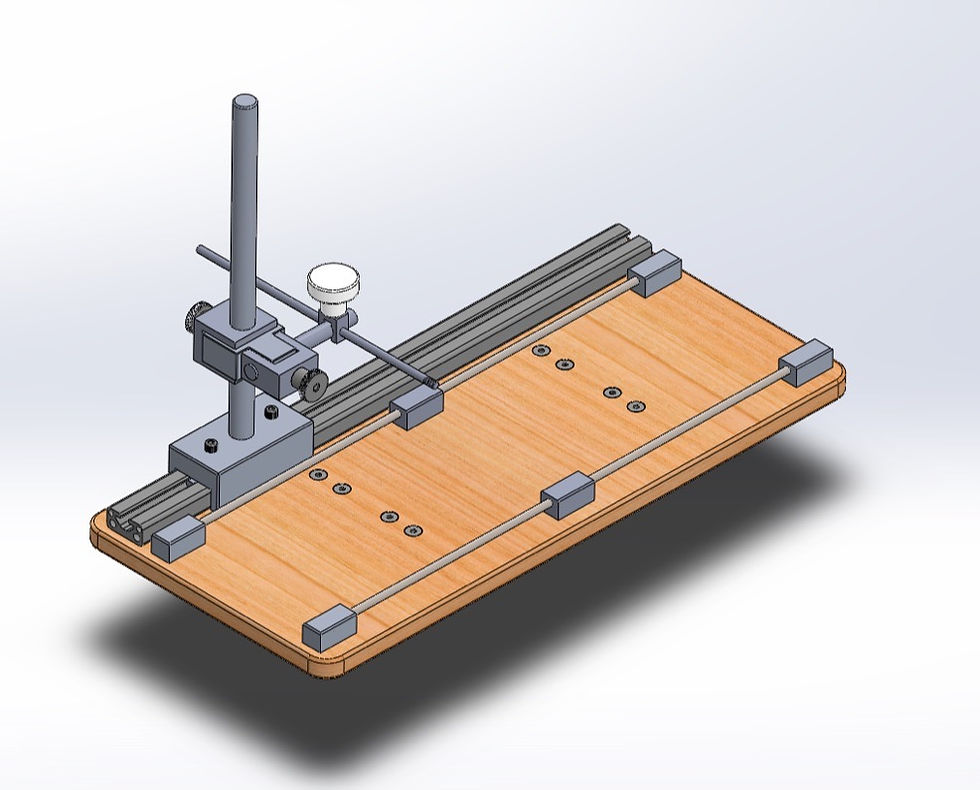
Axiant Engineering designed and constructed a custom mechanomyograph (MMG) neuromuscular monitor — purpose-built for rigorous neuromuscular research and engineered to function in the demanding environment of a clinical operating room.
Every decision balanced scientific validity with real-world usability: compact form factor, precision force transduction optimized for neuromuscular twitch response, and an interface operable in a crowded operating room.
Within three months, the monitor had been designed, constructed, and fully validated. It was delivered complete with a clinical data package and operations manual. Axiant provides ongoing support for the life of the device.
It remains in active use today. Axiant's solution has supported the clinical validation pathway for an FDA approved neuromuscular monitoring system.

THE IMPACT
In 2024, the custom MMG served as the reference standard in a clinical study published in the Journal of Clinical Monitoring and Computing, comparing Senzime's TetraGraph® EMG monitor to mechanomyography across 685 paired recordings in 26 patients.
The results were definitive: TetraGraph® achieved a mean bias of just –2.1% against the MMG reference, the highest accuracy reported in any EMG validation study to date, with 97.2% of measurements falling within clinically acceptable limits.
Agreement held across all neuromuscular block levels — including deep block measured by post-tetanic count, where competing monitors typically fall short. The study confirmed TetraGraph® as a new clinical standard for quantitative neuromuscular monitoring.
CLIENT TESTIMONIAL
"I have spent most of my career in academic institutions, and the vast majority of my funded and unfunded work has been in neuromuscular pharmacology, physiology, and monitoring. I have authored over 200 peer-reviewed, indexed scientific articles in major journals. I have always been fascinated by the challenge of monitoring the effects of neuromuscular blocking agents and their antagonists, and the application of physiologic principles to monitoring the neuromuscular function in the operating room. Early in my career, I was involved in the development of a neuromuscular monitor based on acceleromyography, which piqued my interest and curiosity. Almost 20 years ago, I had the idea of developing a miniaturized (hand-held) neuromuscular monitor based on electromyography (EMG). Over the ensuing decade I developed, with the help of an electrical engineer colleague, an EMG-based, FDA- and EU-approved neuromuscular monitor, the TetraGraph (Senzime AB, Uppsala, Sweden; www.senzime.com).
As part of the regulatory and clinical approval process, the EMG monitor was compared with the reference standard monitoring technology, mechanomyography (MMG).
However, MMG is a complicated, physically large and heavy technology that must meet multiple requirements - so it is not the easiest monitor to use in a busy operating room. For this reason, there are no high-quality and easy-to-use MMG monitors available. As Chief Medical Officer at Senzime, I contracted with Doug Peters from "Axiant Engineering" for the design, construction, and validation of a custom-made MMG monitor. The MMG was designed and tested clinically within three months, and it is still currently in routine use in medical scientific projects. This has been a very professional and personally gratifying experience, and I would be delighted to work with Doug on any current or future projects."
Sorin J. Brull, MD, FCARCSI (Hon), Professor Emeritus at Mayo Clinic College of Medicine and Science in Jacksonville, Florida.
About Senzime
Senzime AB is a Swedish medical technology company focused on patient-centric monitoring during and after surgery.
Their TetraGraph® neuromuscular monitor has received FDA regulatory approval and is used in clinical settings across multiple countries.
Let's Find Your Axis
Axiant Engineering is a boutique engineering practice focused on solving the most complex challenges at the intersection of design, manufacturing, and performance.